How to Track (and Win) Brand Mentions in Perplexity

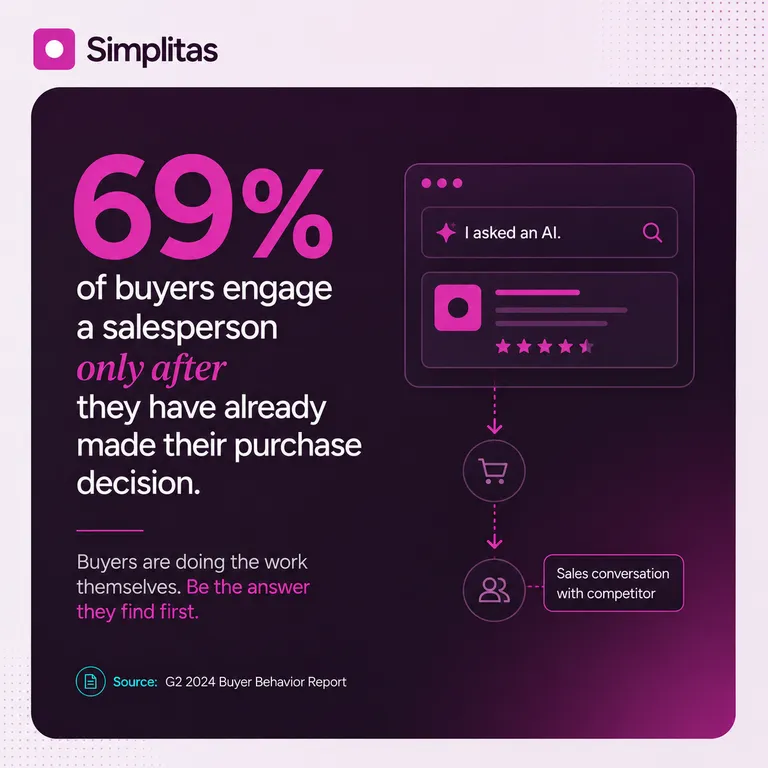
For a decade, my job was simple: push the organic traffic graph on Google Analytics up and to the right. I built SEO playbooks that worked like clockwork. Then, a year ago, that playbook stopped working. The leads were different. They arrived on our demo forms already knowing our product, competitors, and pricing. Their source wasn’t Google, but a new, definitive statement: “I asked an AI.” This reflected a huge shift, where 69% of buyers engage a salesperson only after they have already made their purchase decision[1].
This was the change. Ranking #1 on a SERP is still valuable, but a new gatekeeper now shapes buyer decisions before they ever see ten blue links. I realized the game is no longer about ranking; it’s about becoming a citable source of truth. That is why I started Simplitas, to build tools for this new reality. The first step, however, is understanding how to measure what truly matters in this new AI-driven landscape.
Why Brand Mentions in Perplexity Behave Differently
Lumping Perplexity in with other AI chatbots is a mistake. Its live “answer engine” model makes it the epicenter for B2B research. It uses Retrieval-Augmented Generation (RAG) to perform a fresh web search for every query, synthesizing answers from top results and citing its sources. Unlike a static LLM, Perplexity’s knowledge is always current. This has three direct implications for your brand:
-
A content update can influence Perplexity’s answers in days, not the months traditional SEO takes, so you can test messaging and measure the effect on your positioning at a pace that was not possible before.
-
Numbered citations show you the exact URLs Perplexity trusts on a topic. It is not a black box, it is an open-book test on how to become an authority.
-
The questions people bring are bottom-of-funnel: “compare product A and B,” “vendor shortlists for Y,” “best software for enterprise.” That is your buyer doing final due diligence before they contact anyone.
How to Measure Brand Mentions in Perplexity: The 3 Tiers of Visibility
The cardinal mistake in AI tracking is treating every brand appearance as an equal win. A simple mention is not the same as being the source of truth. To understand your position and diagnose weaknesses, you must differentiate between three distinct tiers of visibility for your brand mentions.
Tier 3: Earning a Basic Mention
This is the lowest level of visibility. Your brand name appears in the AI-generated answer, but your website is not cited as a source. For example, the answer might say, “Competitor A is known for X, while Simplitas offers Y.” This is a weak signal. It means Perplexity learned about you from someone else: a review site, a news article, or a competitor’s comparison page. While better than nothing, it means someone else is controlling your narrative.
Tier 2: Gaining a Direct Link
Here, your URL is a clickable link within the body of the text, but it’s separate from the official, numbered citations at the end of the answer. Perplexity sometimes includes these for user convenience. These are valuable for driving direct referral traffic but are more of a tactical win than a strategic signal of deep authority. It shows you’re relevant, but not foundational to the answer itself.
Tier 1: Becoming a Citable Source
This is the gold standard. A numbered citation [1] links directly to your domain, signifying that Perplexity used your content as a primary source of truth to construct its answer. You are not just part of the conversation; you are the evidence. This is the ultimate goal. And that evidence gets checked; a 2025 study found that when B2B buyers saw AI Overviews in their research, 90% of them clicked through to a cited source[2] for verification.
Execute a Manual Perplexity Audit in 3 Steps
Before you invest in automated tools, get your hands dirty. A manual audit builds an essential intuition for how Perplexity perceives your market and establishes a critical baseline. While this process requires focused effort, it’s worth it; with 94% of B2B buyers now using LLMs during their purchasing journey[3], the baseline data this produces is invaluable. It’s the proof you need to justify a larger investment in this channel.
Step 1: Build Your High-Intent Prompt Library
Don’t just track your brand name; track your customers’ problems. Your goal is to see the world through their eyes when they turn to AI for answers. Start with 20-30 prompts broken down into three categories.
-
Category Queries (60%): Non-branded, problem-focused queries that define your market. This is where discovery happens. (e.g., “best tools for user onboarding,” “generative engine optimization strategies,” “how to measure AI visibility”).
-
Branded Queries (20%): Reputation-focused queries that mention you directly. This is where you test the AI’s understanding of your brand. (e.g., “Hubspot pricing,” “Salesforce vs Competitor X,” “reviews of Notion”).
-
Competitor Queries (20%): Landscape-focused queries about rivals. This helps you understand how you’re positioned against the competition. (e.g., “alternatives to Competitor Y,” “is Competitor Z a good solution for enterprise”).
Your best source for these is your PPC search terms report and sales call logs, which reflect customer intent directly. For a head start, run our free GEO audit to find prompts where your competitors are already winning.
Step 2: Create Your Command Center Spreadsheet
Create a simple Google Sheet to act as your command center. This structured data is what turns one-off searches into strategic insights. Include these columns at a minimum.
-
Prompt: The exact query you used.
-
Date: The day you ran the test.
-
Mention Tier: Record the highest level of mention (Tier 1, 2, or 3).
-
Cited (Y/N): Was your domain a numbered source? (A quick filter for Tier 1 wins).
-
Citation URL: The specific page that was cited. This is your most valuable data point.
-
Competitors Mentioned: A list of rivals in the response.
-
Notes: Critical context on sentiment, accuracy, and the overall narrative.
Step 3: Run the Audit and Establish a Cadence
Always use an incognito or private browser window to ensure unbiased, non-personalized results. Go through your prompt list and fill out the spreadsheet as you go. This first run is your baseline, the ground truth of your current AI visibility. Then, establish a simple tracking schedule:
-
Weekly: Track your top 5-10 most critical category queries. These are your money keywords.
-
Monthly: Track the entire prompt library to monitor broader trends and shifts in the AI’s understanding.
Don’t forget to experiment with Perplexity’s “Focus” modes. Running queries with the Focus set to “All,” “Academic,” or “Writing” can reveal how the AI’s source selection changes based on intent, giving you deeper insights. Consistency reveals patterns a single search never could. If this process feels overwhelming, you can always book a demo to see how we automate this at scale
Where to start
You do not need a tool to begin. Build the spreadsheet, pick twenty prompts your buyers would actually type, and run them in an incognito window this week. Whatever comes back is your baseline, and most teams find it lower than they expected. Then decide whether the gap is worth closing.
References
- [1] “Buyer Behavior Report 2024: Proving Value in the Age of AI.” G2, 2024. Survey of more than 1,900 B2B software buyers. https://research.g2.com/hubfs/2024-buyer-behavior-report.pdf
- [2] Allison, Katie. “Bridging the Trust Gap: B2B Tech Buying in the Age of AI.” TrustRadius, 7 April 2025. https://solutions.trustradius.com/vendor-blog/bridging-the-trust-gap-b2b-tech-buying-in-the-age-of-ai/
- [3] Hieb, Dan. “How GenAI and LLMs are Changing B2B Buyer Research, and How to Respond.” 6sense, 25 November 2025. https://6sense.com/guides/how-genai-and-llms-are-changing-b2b-buyer-research-and-how-to-respond/