Track how often AI names you, and which pages it reads to decide.
100 buyer questions per keyword, asked of ChatGPT every day. You get your visibility and share of voice against every competitor it names, the sites it cites, and the history of each question.
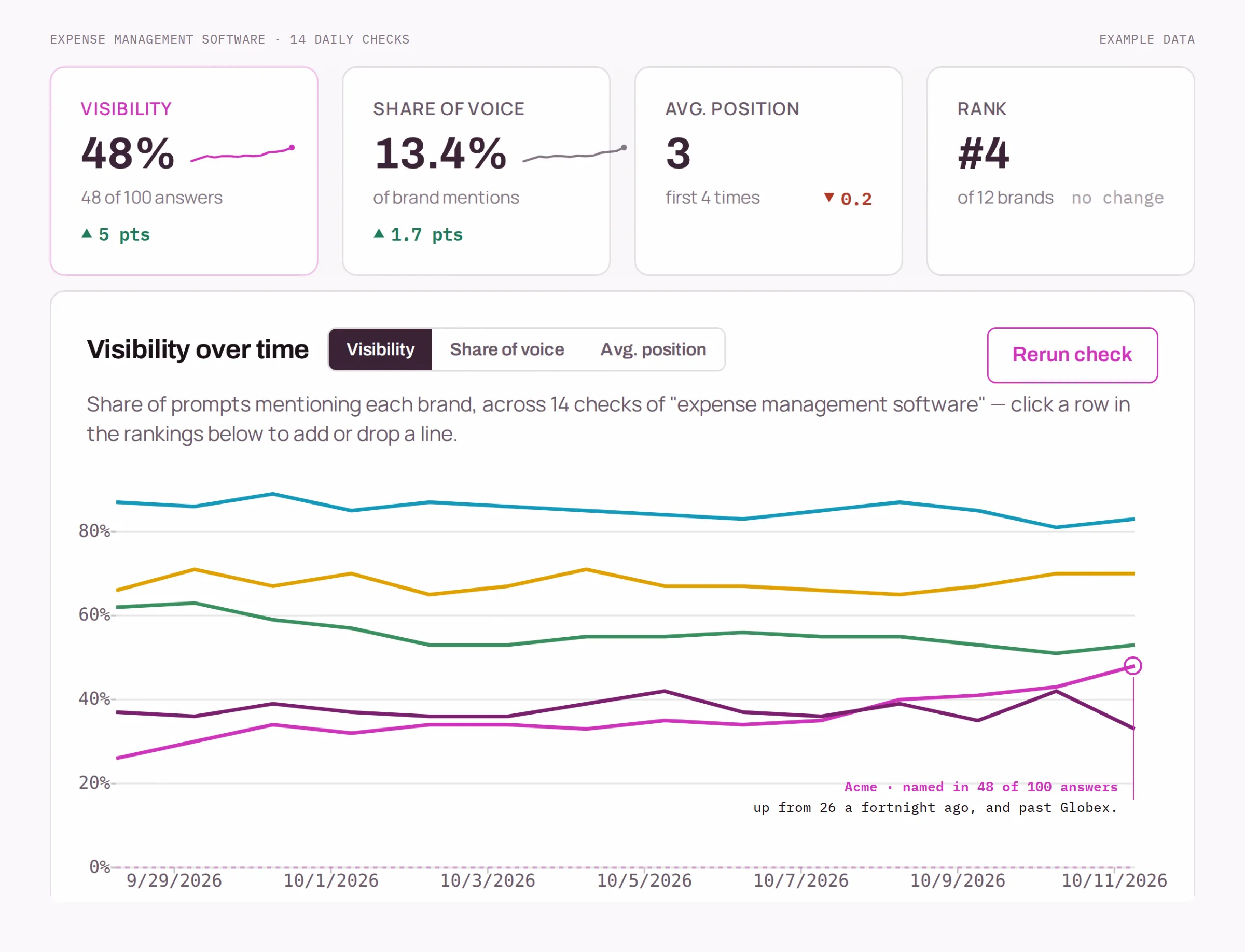
Four numbers, and what each did since the last check
One blended score would hide the difference between being named often and being named first, so the report keeps four.
- 01
Visibility
The share of the 100 answers that name your brand. Named in 48 of 100 is 48%. An answer that names nobody still counts, so the number cannot be flattered by dropping it.
- 02
Share of voice
Your share of every brand mention in the check. Visibility says how often you are there. Share of voice says how much of the conversation is yours, and it only rises when a competitor falls.
- 03
Average position
Where you sit in the answers that do name you. A brand listed fifth in every answer has high visibility and a poor position, and the two are kept apart for that reason.
- 04
Rank
Your place in the league table of every brand ChatGPT named for the keyword, ordered by how many answers each appeared in.
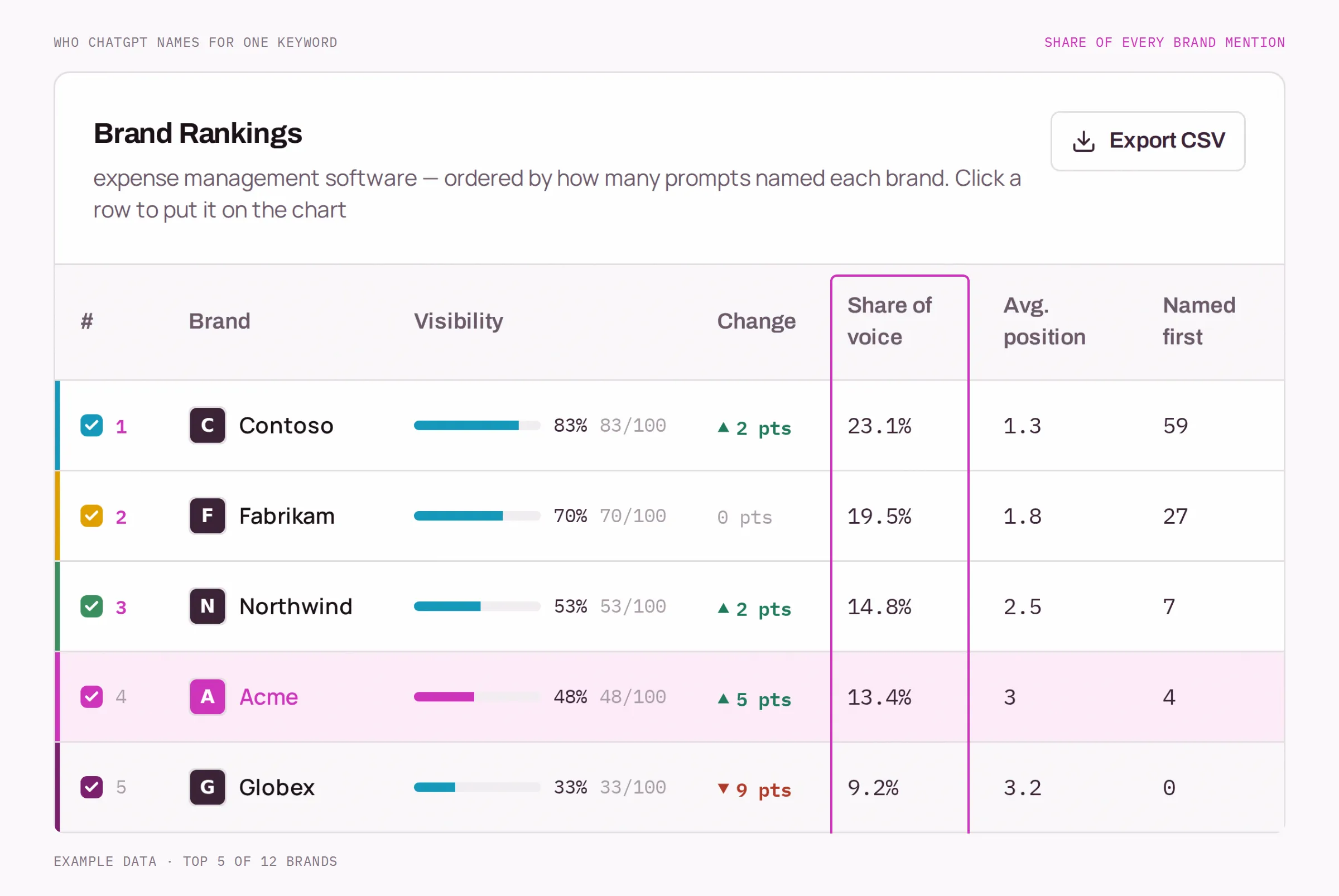
AI share of voice, against every brand ChatGPT names
You do not choose the competitors. Every brand that appears in the answers goes into one table with its visibility, share of voice, average position and how often it was named first, plus its change against any earlier check. The biggest gains and drops sit above it, so a competitor that climbed overnight is the first thing you see.
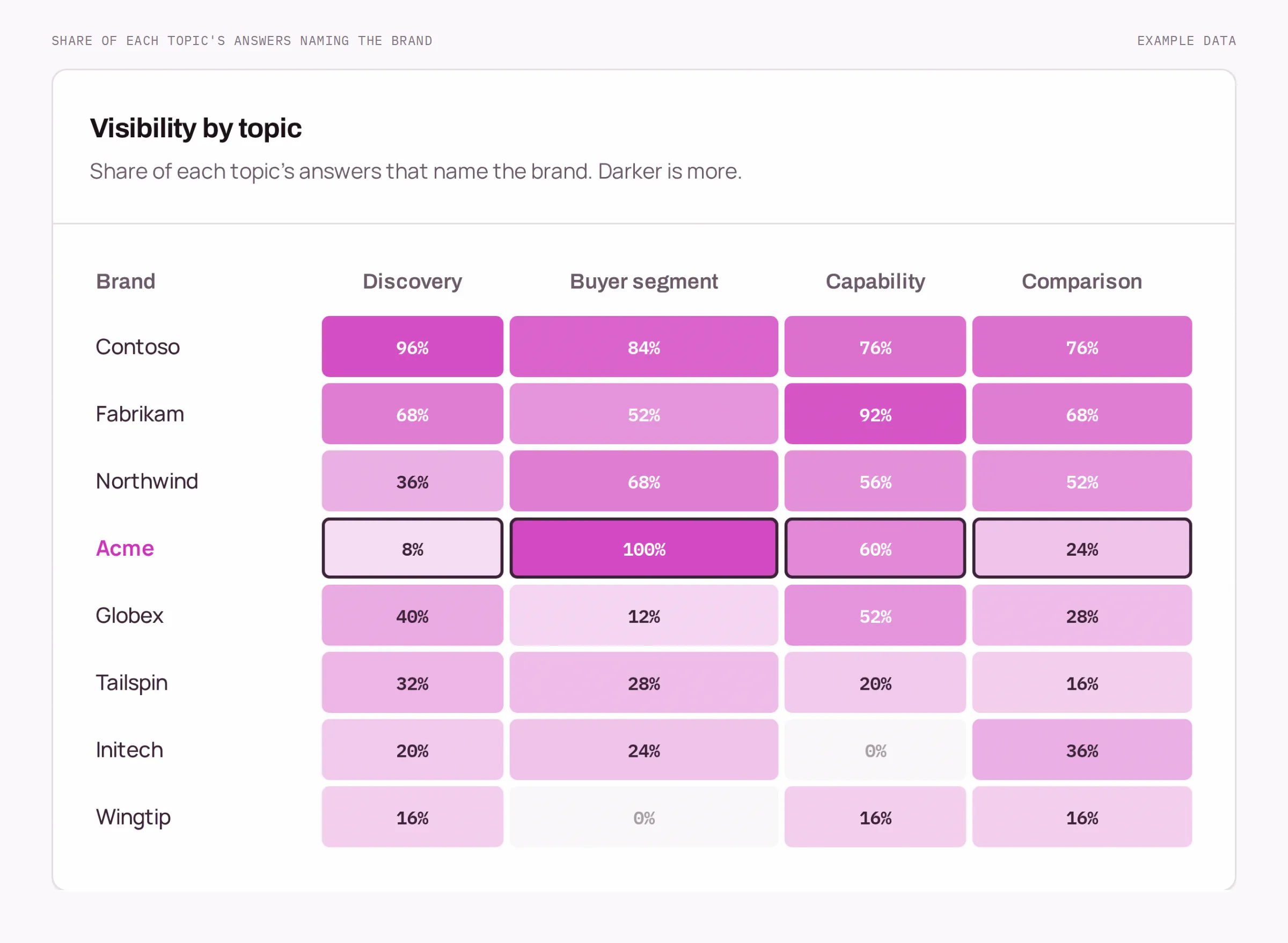
Split by what the buyer was asking
The prompts are written in four groups: discovery, buyer segment, capability, comparison. A brand can lead one and be absent from another, and the grid shows which. Each topic is then given one of four statuses, from where you rank for mentions and whether your own site is among the most cited.
- Stronghold
- A top-three brand here, sourced from your own pages. Keep those pages current.
- Visible, not cited
- Named often, but from other people's pages. Publish your own answer to these questions.
- Cited, not visible
- Your pages are read, yet other brands are named ahead of you. Make each page say plainly what you are best for.
- Needs attention
- Behind on mentions and on citations. Start with the pages ChatGPT already cites for these questions.
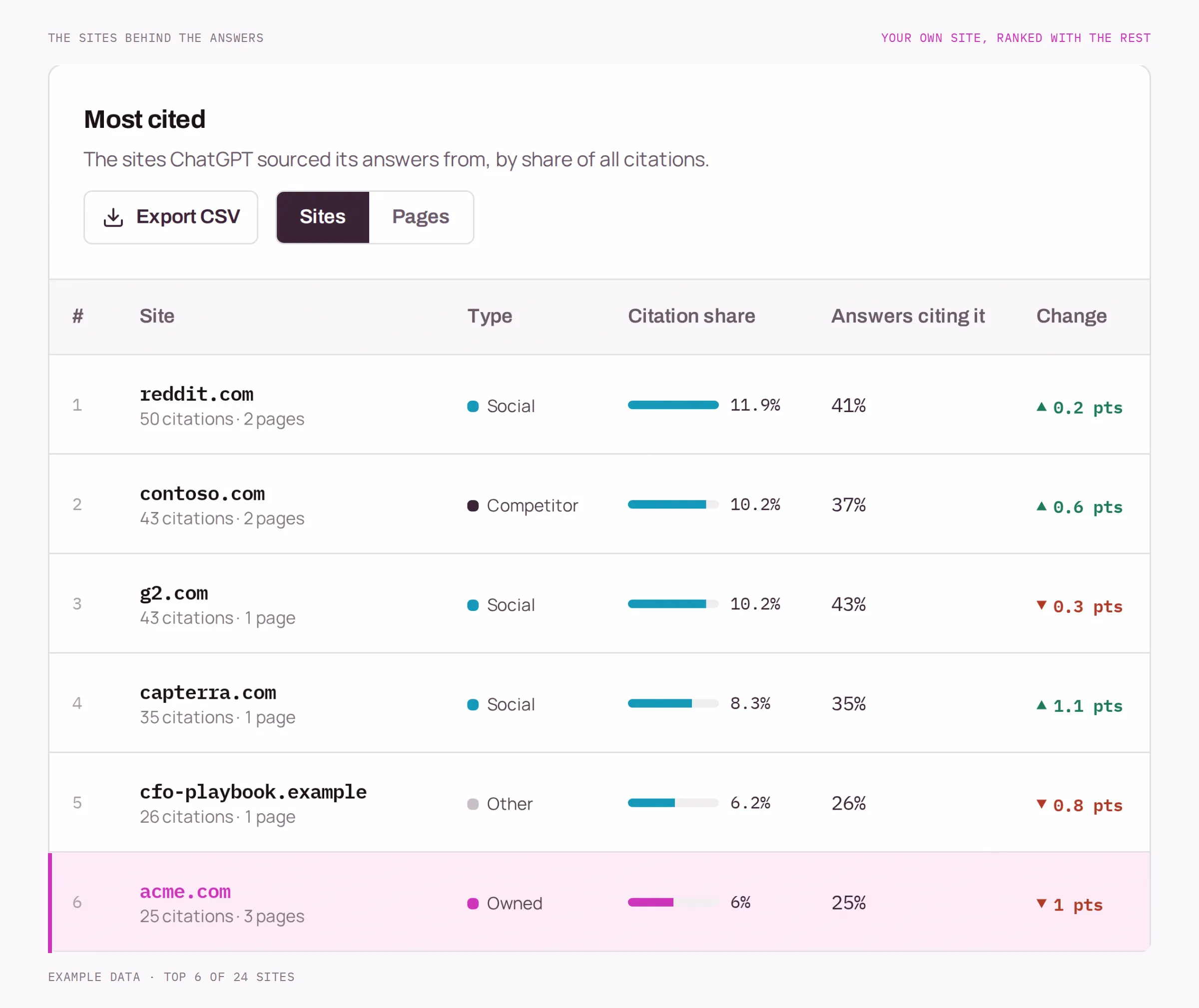
LLM citation tracking: the sites behind the answers
Being named is half of it. The other half is whose pages ChatGPT built the answer from. Every cited source is stored per prompt, then ranked by site and by page, with its citation share and the share of answers that cited it. Your own site sits in the same list as everyone else's.
Sorted by the kind of site
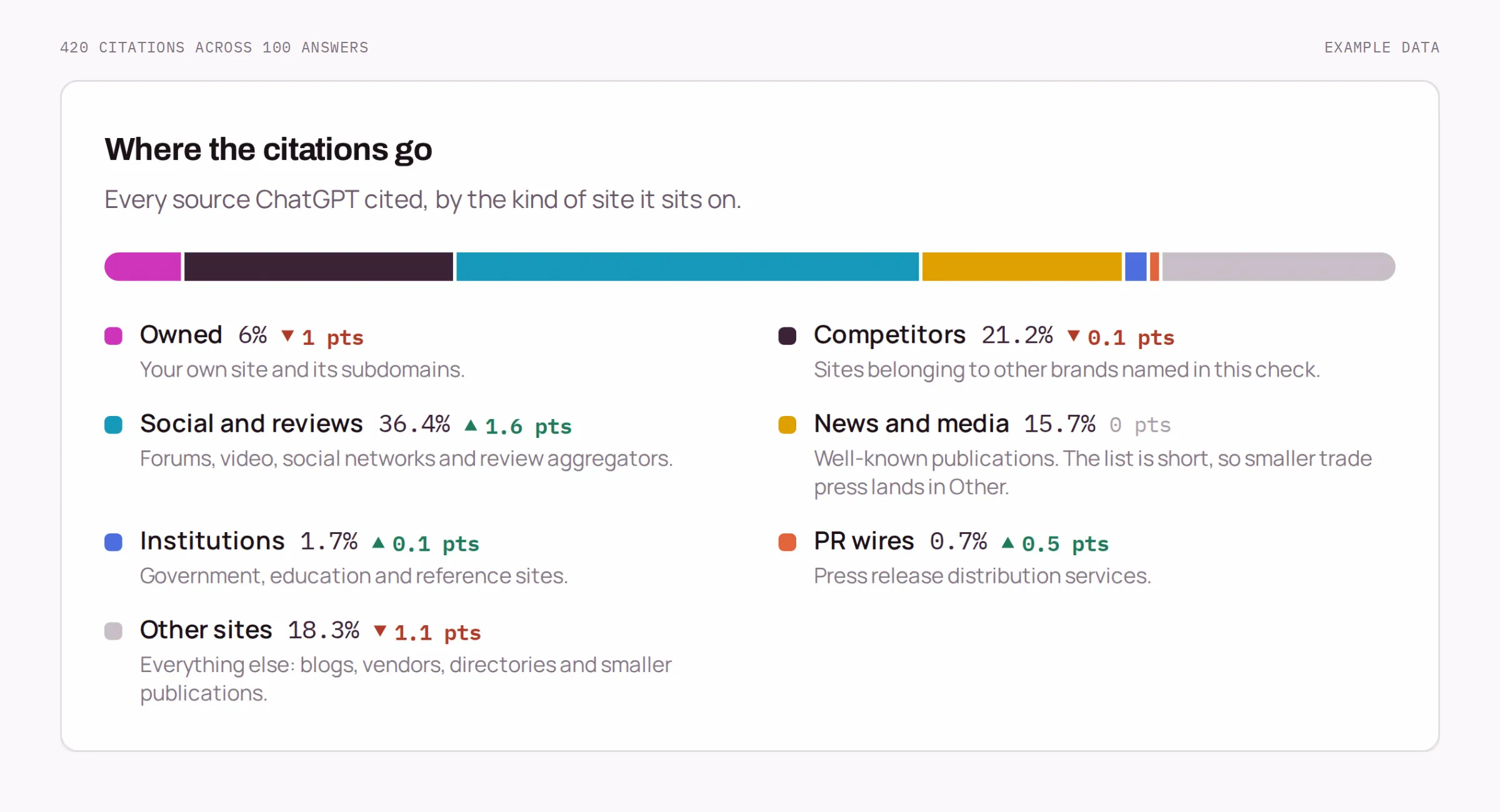
Whether the answers lean on review sites, forums, the press or your competitors tells you which kind of work will move them.
- Owned
- Your own site and its subdomains.
- Competitors
- Sites belonging to other brands named in this check.
- Social and reviews
- Forums, video, social networks and review aggregators.
- News and media
- Well-known publications. The list is short, so smaller trade press lands in Other.
- Institutions
- Government, education and reference sites.
- PR wires
- Press release distribution services.
- Other sites
- Everything else: blogs, vendors, directories and smaller publications.
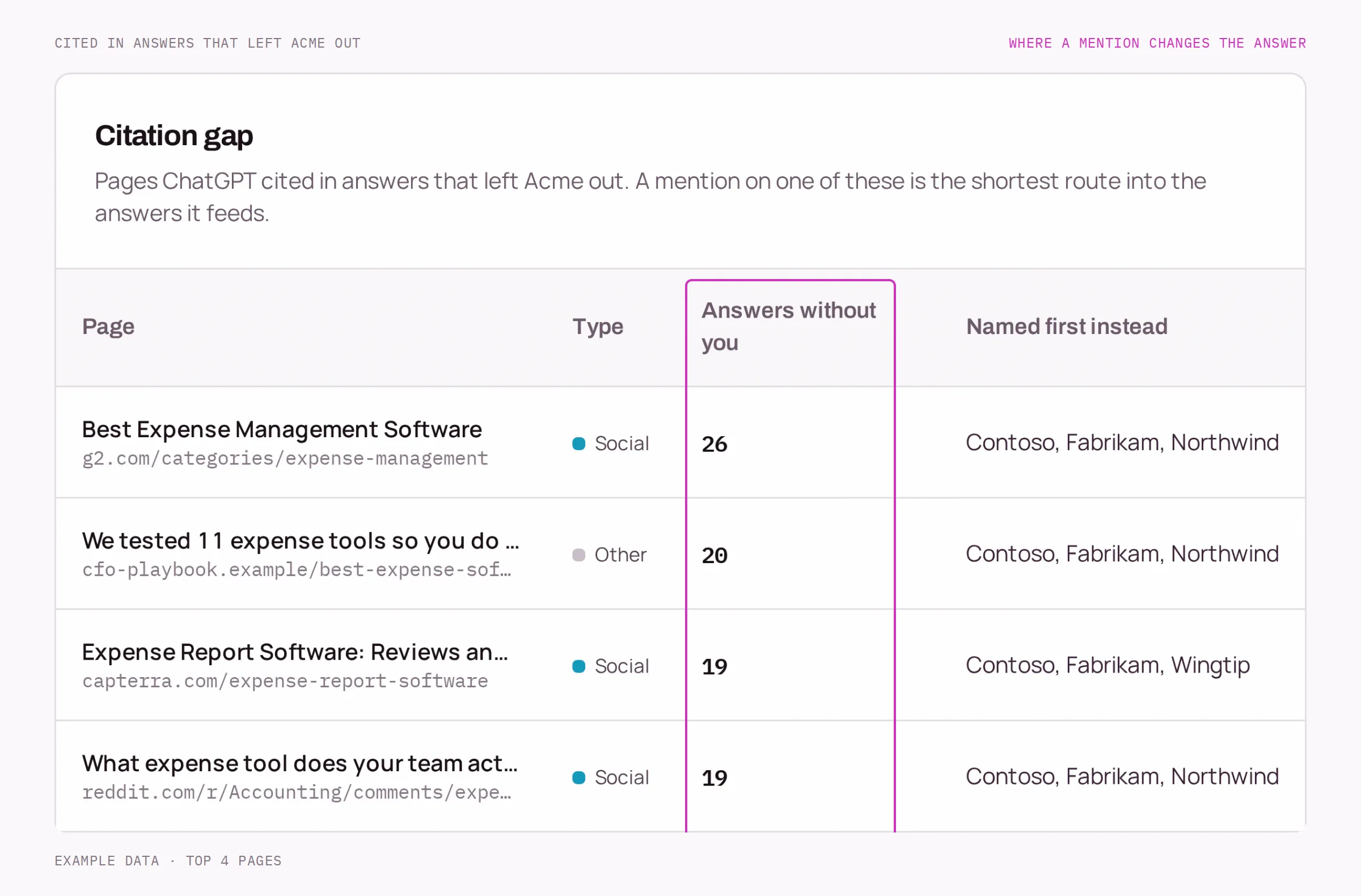
Citation gap: the pages to get mentioned on
These are the third-party pages ChatGPT cited in answers that left you out, with how many such answers each one fed and which brand was named first instead. Your own pages and your competitors' are left off, because neither is somewhere you can earn a mention. What remains is an outreach list, and AI Brand Mentions is the part of Simplitas that works it.
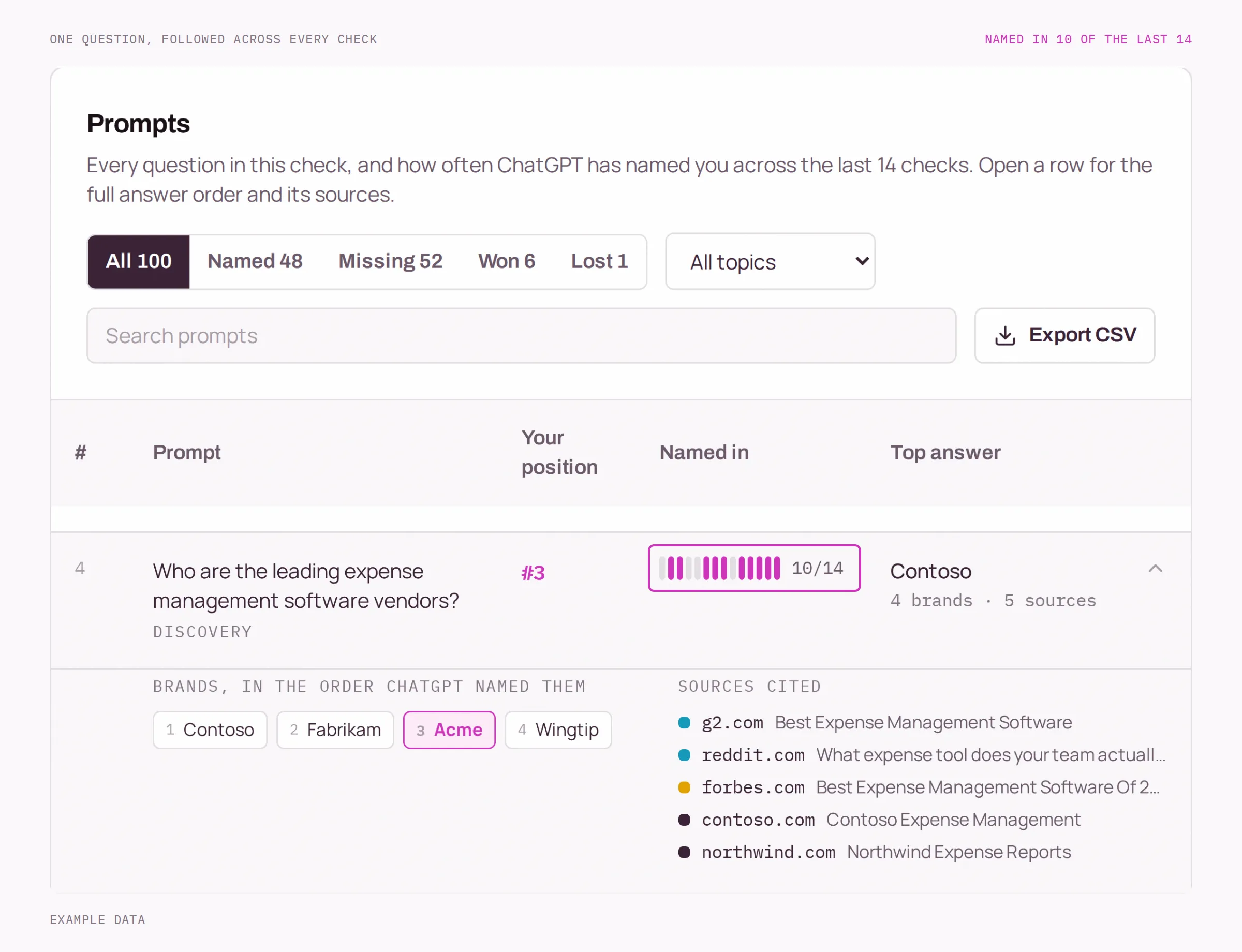
Prompt tracking: one question, followed across every check
Reruns ask the same 100 prompts, word for word, so each one has a history. For every prompt you see your position, how many of the recent checks named you, and whether you won or lost it since the check you are comparing with. Open one for the brands in the order ChatGPT named them and the sources it cited. Every table exports to CSV.
What it does not do
- It asks ChatGPT only. Perplexity, Gemini and Google AI Overviews are not queried, so the numbers describe one assistant.
- The prompts are written for you. You give a keyword and the 100 questions are generated. You cannot yet add, edit or tag your own.
- Citation types are sorted by rule. Social, media, PR and institution sites are matched against fixed lists and domain endings. The media list is short, so a trade publication it does not know is filed under other sites.
- It counts mentions, not tone. There is no sentiment score and no fact-checking of what an answer says about you.
- It shows who read you only in answers. For the bots that fetch your pages and the visits assistants send, see AI Traffic Analytics.
Questions
What is an AI visibility tracker?
It measures how often an AI assistant names your brand when buyers ask about your category, and follows that over time. Simplitas writes 100 questions a buyer would ask about a keyword, asks ChatGPT every one, records the brands named and the sources cited, and repeats the same questions every day so the numbers are comparable.
How is AI share of voice calculated?
Count every time any brand is named across the answers in a check. Your share of voice is the fraction of those mentions that are yours. A brand named in the same answer twice is counted once. Across all brands the shares add up to 100%.
How does LLM citation tracking work?
Each ChatGPT answer comes back with the pages it cited. Simplitas stores those URLs for every prompt, groups them by site, and reports each site's citation share (its part of all citations) and the share of answers that cited it at least once. Sites are sorted into owned, competitors, social and reviews, news and media, institutions, PR wires and other.
What is a citation gap?
The third-party pages ChatGPT cited in answers that did not name you. They already shape the answer, so a mention on one of them is the most direct way into it. The report lists them with how many answers each fed and which brand was named first instead.
Which AI engines does it track?
ChatGPT. Perplexity, Gemini and Google AI Overviews are not queried today, so nothing on this page should be read as covering them.
How often are the checks run?
Once a day for every keyword with daily tracking switched on, using the exact prompts from the first check. You can also rerun a check by hand. The report compares the latest check with any of the previous thirteen.
Can I choose my own prompts?
Not yet. The 100 prompts are written for you from the keyword, a quarter each for four kinds of question: discovery, buyer segment, capability, comparison.
Comparing tools? See how this stacks up against Profound, Peec AI and AthenaHQ.
Start with one keyword
The first check is free and needs no account. Daily tracking asks the same 100 questions again every day, from $49 a month for one keyword.